Never-ending desire to experiment grows by exploring – an artist interview with Jenni Rope
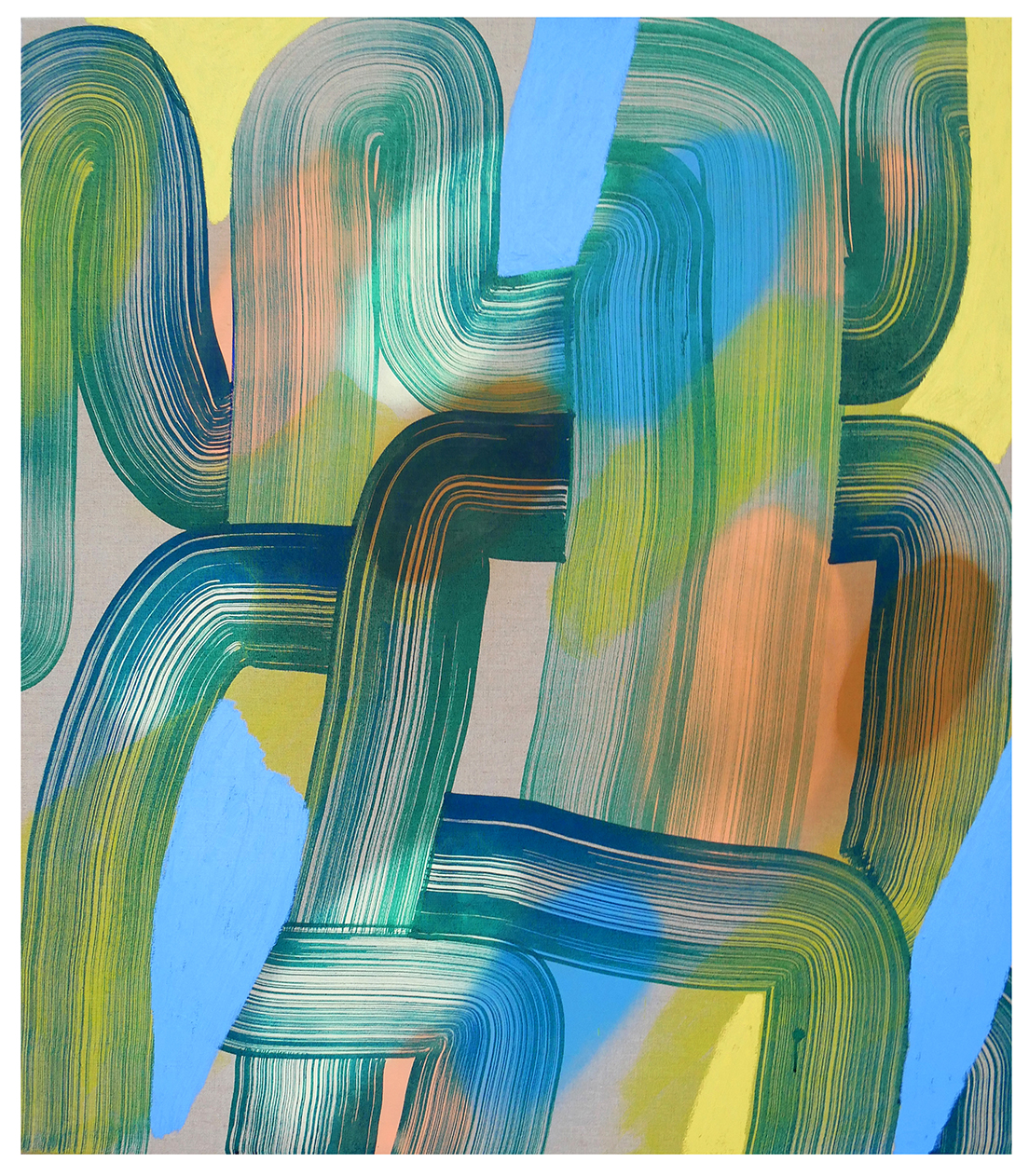
Jenni Rope (b.1977) is an Finnish visual artist working with painting, sculpture, artists’ books and public art projects. Her work plays with sculptural shapes and the spatial dimension of paintings, exploring the abstract terrain between painting and sculpture. Influenced by the world of patterns both in textiles and in the nature her work aims to awaken multisensory experiences through vibrant colour and rhythms of repetitive brush strokes.
I first came across your work in 2003 at the Pori Art Museum when you had done a flipbook project, and the illustrations were displayed frame by frame in the museum’s studio. What has changed in your art over the years?
“It feels crazy that my artistic career really started over 25 years ago, it’s hard to believe. I’ve done all sorts of things, and I don’t regret anything! My early days in comics do feel distant, but on the other hand, I’ve continued to make artist’s books, so I’m still the same person who’s excited about turning art into a book!
Although I mainly paint and make mobile sculptures, I also occasionally make artist’s books, and I’m already planning the next one for next year. An artist’s book is a really accessible art form: it’s economical to make, affordable to buy, and the author can control all parts of the design, printing, and distribution process. Best of all – it works completely independently outside the gallery world. That world also includes super interesting art book events around the globe, which I like to attend in order to meet other people. What interests me is that you can touch a book, unlike most other works of art. It has that sensory aspect – you can feel it more concretely with your hands.”
What has changed about you as an artist? What has stayed the same?
“I still have the same willingness to experiment as when I was young – it keeps my interest in exploring new things alive. There are so many possibilities, why limit your own activities? Of course, it’s important to focus on developing one thing for a longer time. For example, for the last couple of years I’ve been practicing a new technique, painting with oil sticks. Only now did I dare to put those new works on display in my current exhibition at HAA Gallery. I like to experiment with new materials and new scales. Maybe that’s why public art also feels like my own – it has a lot of challenges, but it’s all the more rewarding to see the end result. Nowadays, I’m also braver, and if I don’t know something, I dare to ask for advice. I didn’t know how to do that when I was younger.”
Has a work or work process taught you something about yourself that you wouldn’t have noticed otherwise?
“Quite often in public art projects, you meet people from outside the art field. There could be team members from the construction and real estate industries, who are not familiar with art and are perhaps too nervous to talk about it. Then you notice that when you don’t know art, you don’t know how to appreciate it. And yet, that mutual appreciation is really important when we work together. In projects like this, I notice that I’m not the stereotypical confused artist, but a pretty sharp type, and I like to broaden people’s perceptions of artists.”
I see how your art has grown, but at the same time remained recognizably similar. Installations, sculptures, canvases, paintings and prints – few artists have had the opportunity to work with so many different materials and projects. What kind of dreams do you still have for the future of your works, where would you like to realize an exhibition or a public work?
“I have quite a few different materials in mind that I would like to try, and I have already suggested a concrete sculpture for an outdoor space in a couple of open calls. No more about them yet – but it would be interesting to be able to implement them. Exhibitions are only on display for a month, while a public sculpture can stay in place for decades. I like the idea that people can see my work in the future, and possibly in a different light than today. My other dream would be to do more exhibitions abroad in the future.”
In your master’s thesis at the Academy of Fine Arts, you describe in your working diary how working with paintings is serious and emotional. Building mobile sculptures, on the other hand, is like a game.
How do the properties of the materials – for example, the permanence and layering of painting compared to the lightness and movement of mobile sculptures – affect how you experience the working process and the feelings of making?
“Painting allows for the kind of layering and long-term work that makes it slower – you have to think more about its phases and you sink really deep into it. It’s difficult because a painting can look so different on different days, and even if you think it’s finished, suddenly after six months it feels completely unfinished. Painting is a more capricious medium. I see that in mobile sculptures, shapes are the most powerful feature, so there is not so much opportunity for painterly work in them. It makes my working process easier and lighter. The movement of mobile sculptures also automatically adds more variables to the work, so they can be left more simplistic.”
You made your first mobile 10 years ago. What do mobiles mean to you?
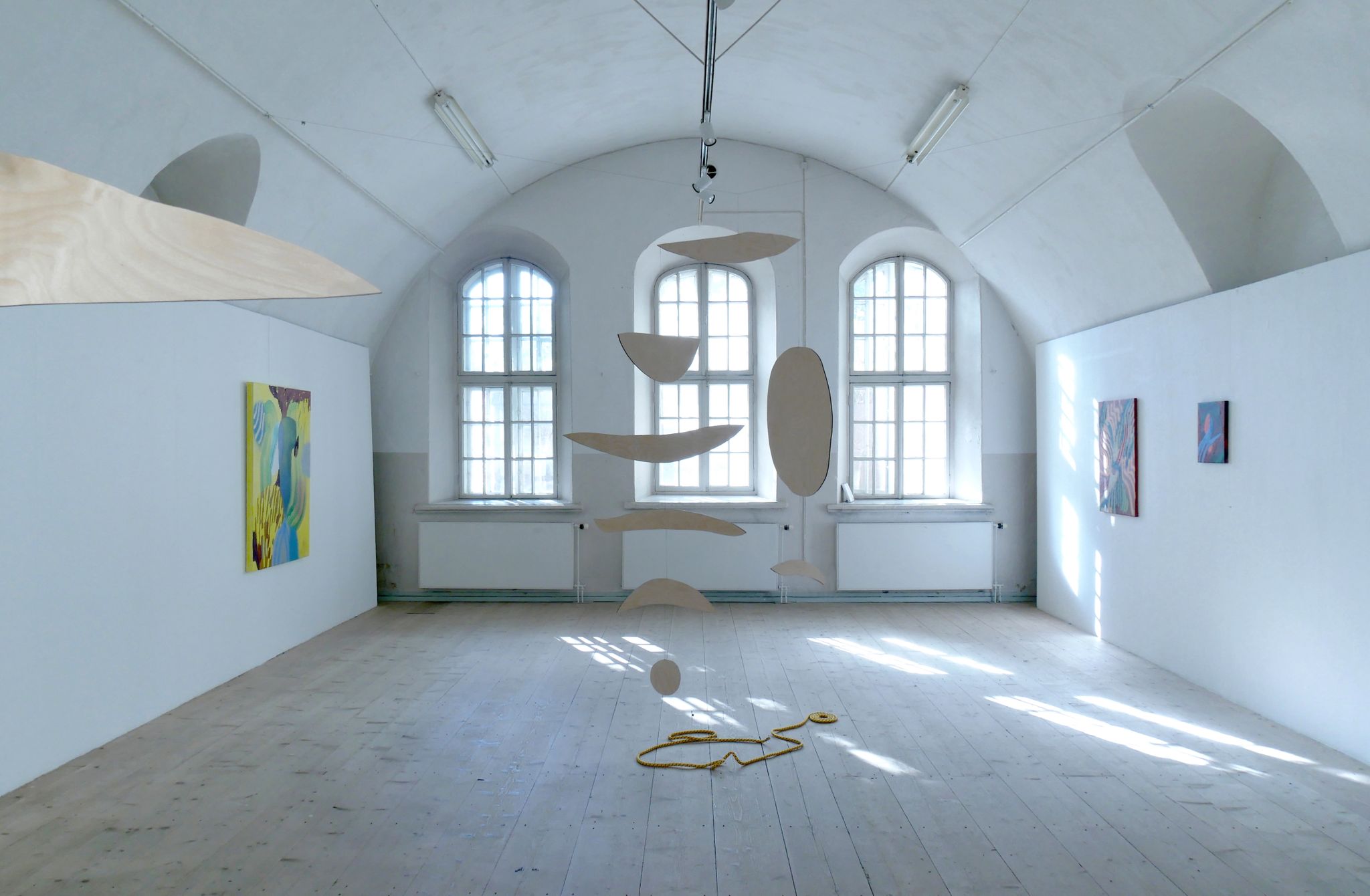
“Mobiles have expanded my work especially in the spatial direction – their movement and changing appearance fascinate me. There’s something really exciting and meditative about them that I may not have fully figured out yet. In every exhibition, I try to make them work in new ways with the paintings. And the possibilities for shapes and materials are endless!”
You are a very prolific artist. Where do you get your ideas from? Do you need special conditions for creative thinking?
“All my ideas are born while doing. I just go to the studio and start working. Quite often I might just clean the studio for a couple of days – it’s a kind of contemplation and making room for something new. The materials and colors themselves are inspiring. I don’t wait for ideas; they always come during the working process, and you already know that the best of them might come through some experiment that went wrong. You need time and peace, i.e. whole days that must be reserved for working alone. I leave my laptop, which has all the more important things to do, waiting for me at home.”
What would you like to tell us about your exhibition at Suomenlinna?
“The space of the HAA Gallery in Suomenlinna is a beautiful hall with an arched ceiling, and it felt good that its shape would descend on all the works. My attempts to control or limit the exhibition always feel a bit forced, and this time it felt more natural to just show the latest works that I’m excited about. Now, for the first time, I’m exhibiting works that, in addition to the acrylic paint and spray I’ve used before, also include oil stick, which I’ve enjoyed using, bringing a kind of drawing quality to the painting. There are three new mobiles, in which I have used unpainted birch plywood and colorful ropes. The main theme of the exhibition was the floating feeling and the presence of the sea. When you paint an abstract painting, you don’t always immediately understand where the painting is going, and it can take years to perceive the themes that are developing. I feel like I’ve been painting a certain thing for a long time: the rhythms of nature and the city, the patterns in plant life and the patterns made by people, the feeling of movement. With them, I have found my own inner world of painting.”
Thanks for the interview Jenni.
Jenni Rope was interviewed by Laura Köönikkä, founder of Finnish Art Agency.
Jenni Rope’s exhibition Kelluva at HAA Gallery 11.9. – 4.10.2025
The exhibition is open Tue-Thu 12-18, Fri-Sat 12-16.
HAA Gallery, Suomenlinna C1.